Backtalker - Kimberlé Crenshaw
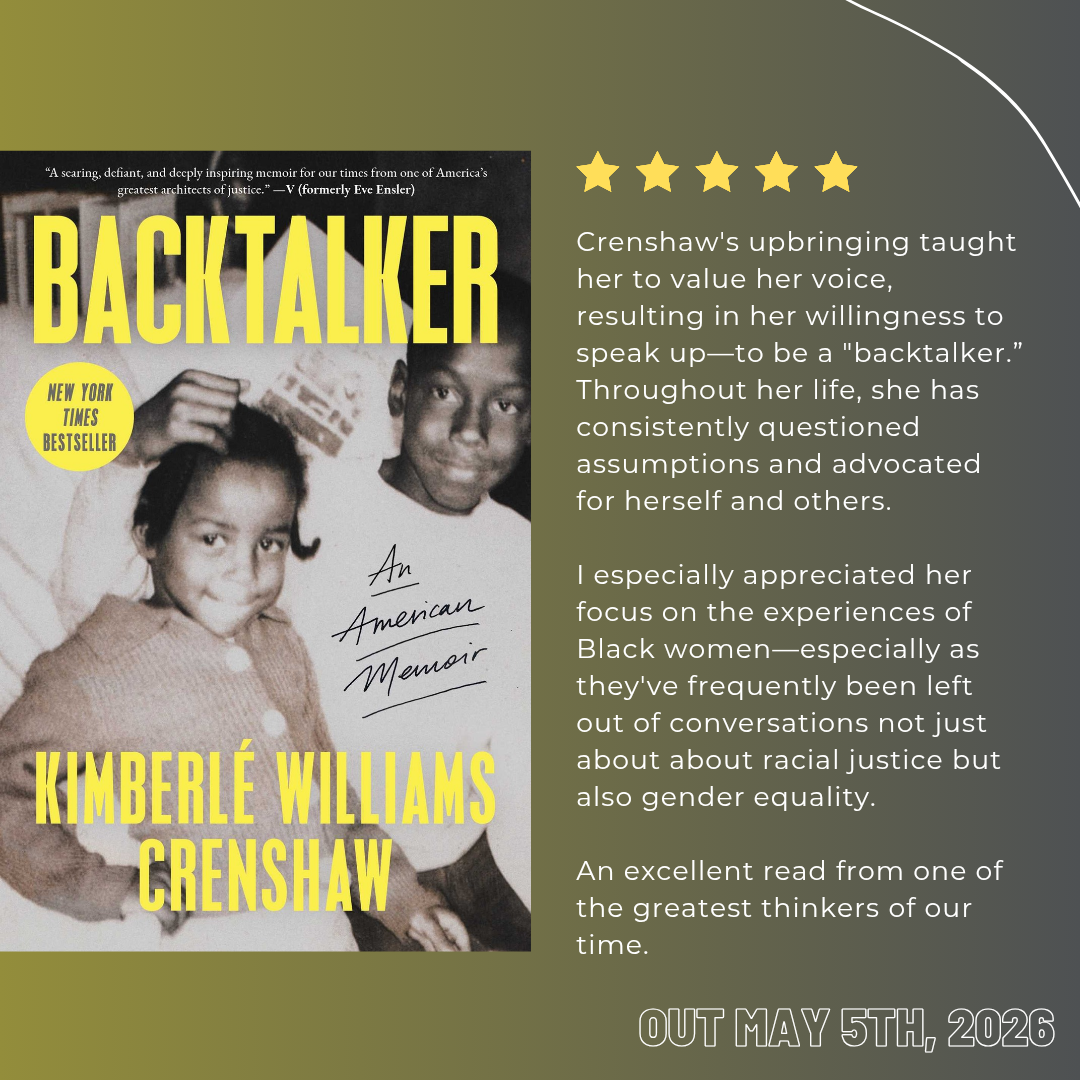
I started reading “Backtalker” familiar with Kimberlé Crenshaw's work on intersectionality, but what I appreciated most about this memoir was the opportunity to understand the author's life experiences that shaped those ideas.
Throughout the book, Crenshaw shares her journey from childhood in Ohio through Cornell, Harvard Law School, and her career as a legal scholar and activist. She shows how her experiences as a Black woman often couldn't be explained by race or gender alone, but by the intersection of both. Rather than presenting these ideas as abstract theory, she presents them in real-life moments that are personal and relatable.
Some of the strongest parts of the memoir focus on her family and childhood. Her parents taught her to value her voice, and that ultimately resulted in her willingness to speak up—to be a "backtalker.” Whether confronting unfair treatment in school or challenging larger systems as an adult, Crenshaw consistently demonstrates the importance of questioning assumptions and advocating for herself and others.
I especially appreciated her focus on the experiences of Black women—especially as they've frequently been left out of conversations not just about about racial justice but also gender equality. The memoir also provides her perspective on major cultural and political moments, including Anita Hill's testimony and other events that shaped public conversations about race and gender in America.
At its heart, Backtalker is about finding your voice and using it, even when it's uncomfortable. It's a thoughtful, engaging memoir telling the story of one of the most influential thinkers of our time.
In gratitude to Simon & Schuster for the Advance Reader's Copy.